

One of the benefits of being a paid subscriber is that you get to pick a topic for me to write about, as long as I am qualified to write on it. So no nuclear physics, please.
One of our newest paid subscribers (thank you! It really does help!) suggested that since I have a background in the labor movement, I should write some reminders about what unions do and why they are important. Here you go!
When I was an organizer of nurses for about five hundred years (closer to twenty but it felt like five hundred), nurses would commonly say, “I’m not really a union person.” That’s code for, “I’m not working class,” and in Philly, it’s also code for “I’m not black.” Here, hospital service workers (nurses’ aides, transporters, environmental services, etc.) were long organized into a union called 1199, but the nurses were, for the most part, not. So we were pushing a big boulder of race and class identity up the hill every time we organized a hospital.
My answer to that statement, made by thousands of nurses over the years, was:
I’m not really a union person either. I didn’t even know what a union was until I joined one to put myself through college at Yale.
That’s code for, “I’m just as well educated as you are, in fact better, and I can help you improve the unpleasant situation in which you currently find yourself.”
Well, that’s almost what it’s code for.
It was essential to slap down that idea that the nurses’ education or professionalism made them too good to join a union. When their wages stagnated, their retirement was slashed, their health care costs went up, and the number of patients they were expected to care for shot up to the level of truly dangerous (stats on your chances of dying in the bed after a routine surgery going up with every patient your nurse has over six are real), they called the union.
So there I was. Day after day after night after night in every diner, McDonald’s, and even a lot of people’s homes (so nice to have house meetings, it’s where I was introduced to Party Lite candles and Bath and Body Works hands soap, years ago), educating about how workers, even professionals (you have to slightly hold your nose as you say that to get just the right affect) could come together and organize to have a say in their work lives.
So to say I am pro-union is correct. Unlike a lot of people to whom the phrase is now applied, unions really did build this country. By setting a point in wages that other employers could not fall far below without losing workers, union workers raised everyone’s wages. Unions brought you the weekend, the forty hour work week, child labor laws, retirement for normal people, even public education which was largely created as a way to get children out of the factories, something it remains relatively good at to this day.
But wait: the forty hour work week is mostly a myth now, lots of people don’t get weekends or are desperately picking up shifts and gigs on the weekends to make ends meet, there is still child slavery, and old fashioned pensions have gone the way of men wearing top hats.
So what is up with the unions?
As an organizer, I used to point to the fact that I was born just six years before Reagan took office, with his aim of destroying the labor movement, so I was joining the movement to witness the decline. But the decline started way before then, when the Communists (who were good at some things, like organizing) were run out and the forces of nepotism took control of way too many unions. Jobs went South and then to Mexico and China, immigrants who were way too scared to join unions took residential construction jobs with no penalty whatsoever to the Americans hiring them, and so on.
But mostly, I think, Americans got very comfortable.
They really thought that things would be just fine if they showed up, did their jobs, and went home. They forgot how hard won the idea that workers should have rights at all was. They lost the will to fight.
I get it. I didn’t get it when I was younger, but I get it now. Life if hard. If things are basically okay, if you can pay your bills without selling your children or prostituting yourself on the street, it is hard to find the energy to do much other than work and take care of your family. Most people don’t want struggle - in fact, it’s sorta messed up that some people do. There is a reason why “deranged” and “unhinged” are such common words on Substack these days.
The attack on the labor movement was relatively subtle. The National Labor Relations Act, which set down ground rules by which workers could organize and bargain with their employer, was meant to create labor peace, and for a long time it did. But bosses decided to just ignore it at a certain point. They started hiring anti-union consultants who would do everything within and outside the law to prevent workers from organizing. My young life, age 21 - 38, was filled with fighting these high-priced, truly nefarious consultants. They lie (that’s legal), use incredible psychological intimidation tactics, and make great opponents for people who are hyper sensitive to any change in the environment. My natural anxiety (which is infinitely better now, with age and careful lifestyle), was perfect for leading organizing campaigns because every small change in a workers’ behavior really did mean that management’s campaign had gotten to them.
[Side note: just realized this: that extreme sensitivity, with the anxiety removed, is also very good for teaching. I know when something is up with a kid. A child who is normally annoying suddenly starts being quiet: something may be very wrong. A child who is usually happy is suddenly cursing and being argumentative: same. Everything matters.]
I won’t go into too long a story about my twenty years of organizing. It’s too complicated to explain to an outsider, and hard to believe if you weren’t actually watching it happen. It can be summed up in this common dialogue with a worker:
Boss does something bad, like slashes retirement.
Worker: Can they do that?
Organizer: They just did.
I organized professionals, so I had to look more professional than the boss. I wore suits, or at least skirts and jackets, and heels, almost every day. I was paid very little at first, so I haunted the Ann Taylor factory outlet and Payless shoes. I can’t believe I walked on those cheap heels for so long. My feet paid the price. Could have been worse, I guess. I wasn’t a ballerina!
The union I gave a decade of my life to as Director of Organizing was truly good, in fact, quite amazing. We were a start up of sorts: a group of nurses in Pennsylvania had left two international unions where their interests were not being represented and founded their own independent union. They recruited our Executive Director, with whom I’d worked in my first union job, and he recruited me. Over the years I ran many campaigns, organizing and contract campaigns, and helped lead quite a few strikes. It gives you a different perspective on what pressure is.
Unions existed to give workers a voice on the job, some protection from unfair and at times evil behavior on the part of employers, and for quite a while unions made an American middle class lifestyle possible. Some were better than others, to put it quite mildly.
My reader asked me to address why unions are still important.
I strongly believe that they are. Without at least the threat that workers will organize, employers have less incentive to pay fairly and provide any benefits at all. The middle class will likely continue to wither away as unions lose more and more power.
Will the labor movement make a resurgence?
I doubt it. To paraphrase a good friend of mine who is still in the movement, over time the infrastructure of the major unions has lost so much in the way of resources that there isn’t a long standing, multi-generational cadre of dedicated organizers who can do the hard work of helping workers fight for the right to organize and for good contracts. Workers do not do this on their own. Nurses know how to provide nursing care, not how to organize a union or negotiate a contract, and so on for every profession and trade. There must be a deep bench of very strange people who really do give their lives to the movement to make it successful. That has been eroded over time, and a bunch of young people who want to organize their local Starbucks aren’t going to replace it.
The kind of people who are attracted to the idea of unions are, as a rule, the worst people at organizing them. You know the kid who has a problem with authority, complains about everything, and smokes weed on break? No one follows him. Workers only organize when the good workers, the respected ones, get so fed up that they decide to organize. If the best nurses in the hospital are not for the union, you have no campaign.
The gig economy makes it very difficult to organize, just as a structural matter. Labor laws were made to regulate large operations, not disparate groups of Uber drivers. There are ways around that, of course, but it’s harder to get around the combination of economic desperation and lack of investment in the job that many if not most gig workers have. I’m not blaming the workers - it is what it is.
It’s not like the labor movement needs any help with its decline, but to look at the far left leadership of some prominent unions, you would think they were hellbent on digging their own graves. While the teachers’ union was very helpful to me personally when I was a member as a district employee, I am horrified by the political stances and unprofessional actions leaders are taking. If you follow the NAVI K-12 Extremism Tracker Substack you’ll see what I mean. I am so glad that the charters do not have these unions and that as either a sub or a charter employee I’ll not contribute in any way to extremist political action that has nothing to do with educating the children.
Charters also have flexibility to do things that schools with unions don’t. This is good. They can create innovative programs and recruit people with non-traditional backgrounds. They can reward teachers for performance, not just for longevity. I think this is good and I’ve seen it in action. In the schools where I work, there is NOT an adversarial relationship between teachers and administration. The teachers are always telling me how much they appreciate the principal and I see the administrators on the floor supporting teachers and students every minute of every day. Not hiding in their offices doing paperwork.
I used to get really annoyed when people would say, “Workers don’t need unions unless they have bad management.” Now I see things a little more in shades of gray. When unions take political stands that are not conducive to education (including encouraging students to walk out of school for causes that are on the other side of the world and on which teachers should not be taking sides in the classroom), when unions prevent innovation, and when they hold students hostage because they resist change - well, I’m not for that. And if you had to choose between putting your child in a failing school and putting your child in a charter that was doing well, you would agree with me.
When I was a union organizer, we fought to raise the standards: not just in pay and benefits, but for patient care. Our number one priority was always safe staffing. We fought for an end to mandatory overtime and won it in two states because it is not just bad for nurses, it’s extremely dangerous to patients. We fought for quality care.
For eleven years now I’ve been missing that rush of energy that comes with being on a team of people united in one clear, powerful, meaningful mission. I am so far from a loner - I’m what you might call an extreme team player. When my subbing schedule for the day gives me the last period off, I insist on staying to cover a class so that a regular teacher doesn’t have to. I volunteer for lunch duty because I love seeing the kids have fun, especially when they get to be on the playground. I believe in the mission like I haven’t really believed in anything since I left organizing.
Equality shouldn’t mean bringing everyone down to the lowest common denominator, whether it is workers or students. It should mean giving everyone the best chance to succeed.
Even when I was an organizer, I was not all that ideological. I wanted the workers to have better lives and the patients to get better care. When an idiot anarchist said to me, “Big labor is not revolutionary,” I think I told him to get off my couch and stop drinking my beer. But I agree with him. Labor organizing is a way for workers to improve their working conditions and better provide for their families, thus improving things for everyone, without bloodshed, chaos, and all sorts of things that leftists fantasize about but would not so much like if it came to their own door.
Union organizers, it seems, no longer wear heels. I’m horrified when I see pictures of people who work for my old union now sporting pink hair. Pink hair is all well and good, but it is not the look that appeals to nurses, who tend to be more conservative in their fashion and often in their politics. I was the fashion police back in those days, teaching young organizers to leave their identity politics at home and come to work dressed so that actual workers would not think they just rolled out of jail after a protest.
Ah, things are different now. I’ve traded in my Payless heels for teacher shoes and cat socks. To everything there is a season.
But I remember what it feels like to be all in. To be able to say, “I can do this,” knowing how hard it is, how much it will take of the life energy I have, but that it will give me back something I haven’t had in over a decade. What it feels like to wake up in the morning already knowing that I’m going to be doing the most important thing I could be doing with the people I want to be with. To love Mondays and be a little sad on Fridays, but happily say, “See you Monday!”
I remember what it was like to have coworkers I’d follow into battle, and to have thousands of workers follow me into what is about the closest thing you can get to a war without violence. 1550 people on the street on strike, many of them about to lose their houses if we don’t get a contract, and we are in negotiations for 96 hours straight…
So yes, I can handle pressure.
And there are things that are better than worth dying for. Things worth living for.
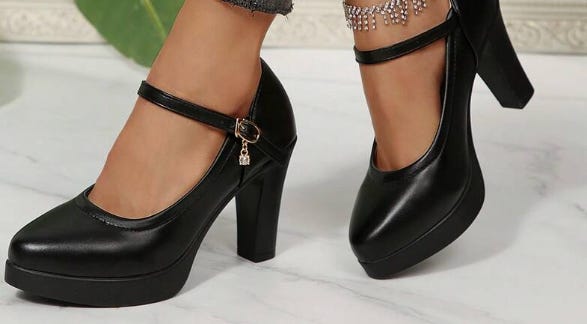
I could probably still rock these shoes, and they are only $7, but they would be totally inappropriate for school. However, if anyone wants to take me on a date, I am accepting invitations. Weekends only - I don’t go out on school nights.
XO, Ms. Smith
The nurses you had to organize were probably 'anti-union' because the one they knew was 1199. I can't speak for the one where you were, but the one in my neck of the woods did some rather unethical things.
NYState Nurses Assn was my union (I'm now retired). It also spoke out politically where it shouldn't have stuck its nose, but it brought about the 1st ever nurses strike where I used to work over the issue of better staffing. While I worked there, the threat of a strike got the wanted results. And to show you how they put their money where their mouth was, they had the choice of using a particular 'pile' of $ for staffing or for retiree dental benefits, & chose the former.
I knew a man who had his own company. His employees rejected union membership because he always gave them more that the union would have. So in a way, they also benefited from the union.
From my really not knowledgable perspective public sector unions- where workers and management are intertwined- the union members donate campaign funds to elected officials- really sullied the idea of a union.