
Adam Smith Had a Goldendoodle
What is your intellectual pedigree?

I love teaching smart kids. I love teaching hard working, polite, well-behaved, delightful smart kids.
About seven weeks out of the year I get to teach SAT prep. The kids, at least the vast majority of them, are highly motivated, from families where respect for education and teachers is foundational, and they are so sweet! They aren’t the humorless, stressed out critters that jealous people make them out to be. They are fun, playful, loyal, and just plain GOOD KIDS.
I bring my absolute best everyday and these kids are the biggest reward a teacher could ask for. You’d think they’re my grandchildren, the way I go on about them! But really, they are the best kids ever.
They are fun to teach because they respond to challenge, something out of the ordinary, with curiosity.
I teach a passage on the SAT about Adam Smith’s idea of the invisible hand. You may associate the term with Smith, but surprisingly, he only mentioned it once in his writings. It was kind of a throw away line, a short stab at mercantilism, the dominant economic paradigm of the time.
(I could spend a class teaching “paradigm.” My mom could spend a year. We are word people. The kids love that my mommy was a librarian. That explains why these words are fun for me.)
Twentieth century economists were eager to show that individuals pursuing their own self-interest would create aggregate (as a group, putting together) benefits for society. They picked out this fairly unimportant concept from Adam Smith and elevated its importance in an effort to secure their own intellectual pedigree.

This is Chloe. She looks exactly like Sunny, our golden on the farm. I know her Mommy and Daddy now, and she comes running when she hears me. She flops over for belly rubs immediately and runs in the heat to greet me even though she is twelve now. She prefers the snow though. What is her pedigree? Pure golden retriever.
I’ve taught this question for two years now, and I teach the concept of “intellectual pedigree” by asking, “Who has a dog?”
The first year I taught it, the most vivacious young lady in my last class of the day shot up her hand. “I have a dog Ms. Smith!”
I loved this kid. She wasn’t always the fastest with the answer, but she worked incredibly hard and had a personality that lit up the room.
“What kind of dog?”
“A sheepadoodle!”

Needless to say, it became a class about a sheepadoodle.
This year, I taught it the same way. This year I am teaching six, not three, classes, working six, not three days a week. Two cohorts: Monday, Wednesday, Friday and Tuesday, Thursday, Saturday.
First class: one of the young ladies helped me illustrate the point because she has a goldendoodle.
Second class: a young lady has an Aussiedoodle! That’s an Australian Sheppard and a Poodle!

Look at those paws!
Next class: another goldendoodle.
At this point, it’s seeming to be an association that is not spurious (are you getting how many SAT words I’m teaching you unsuspecting readers?)
Middle class of the day: one girl has a Burmese Mountain Dog. Another has… wait for it…

A Burmadoodle.
Most of my students do not have pets. Most of my students are of Indian descent, and it seems to not be such a thing to have pets. Many of them want cats when they grow up. But those who do have dogs have some version of doodle, and when we connect that concept to the phrase “intellectual pedigree,” it is etched into their minds forever.
I wasn’t that into economics in college, even though all the hot guys were. I was a history major focusing on religion, binge reading Augustine for reasons I only now recall. But these days I love the economics passages. I think differently now, three decades after I graduated from Yale. Little things that I let pass by have importance now.
Did Adam Smith have a goldendoodle? I don’t know. This was all I could find:
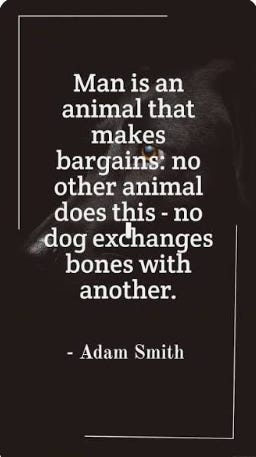
I assure my students that I am no relation that I know of to Adam Smith. They laugh because their chronological and historical understanding shows them that it is very unlikely that I would be, so it’s funny. If they knew I was Scottish though…
Today one of the TA’s - all kids who are alumni of the program and did really well on the SAT - came in to give one of my classes a pep talk. There is a way that people of the same generation can talk to each other that others simply can’t. It was marvelous to listen to through the wall.
I’ve been thinking a lot about what I want to do with the next part of my life. I want a secure job with benefits, of course, and I want to be able to contribute to the success of kids like these kids. I could do this by being a lobbyist for school choice and charter schools nine months a year and teaching SAT in summer (IDEAL WORLD!)
Finally I understand what side I am on: the side of American values, which happen to be embodied in the immigrants whom the Left doesn’t love, the people with brown skin who outwork white people and are incredibly successful.
The Left seems to hate those who are successful, especially if they have overcome obstacles. If you don’t continue to fail, continue to need a handout from the government… well, you must have cheated. And your vote can’t be bought with government programs or the promise of a higher minimum wage.
I tell my students that I want them to become leaders of this country, and I stand by that. They inspire me every day by bringing their A game, all the intellectual power they have plus their happy faces, to camp, when many of their friends are just having summer fun. These are the people who live American values.
Too many white Americans have forgotten our values. Remember when being smart, doing your work, showing up on time, and being polite and respectful got you good grades, status and a good job? When it wasn’t about claiming victim status or being the most oppressed?
Those times are coming back, and I’m happy to play a part in ushering them in.

Sunny would be proud.
"These are the people who live American values." Easier said than done, but you're showing them the way.
I absolutely love goldens!!!